
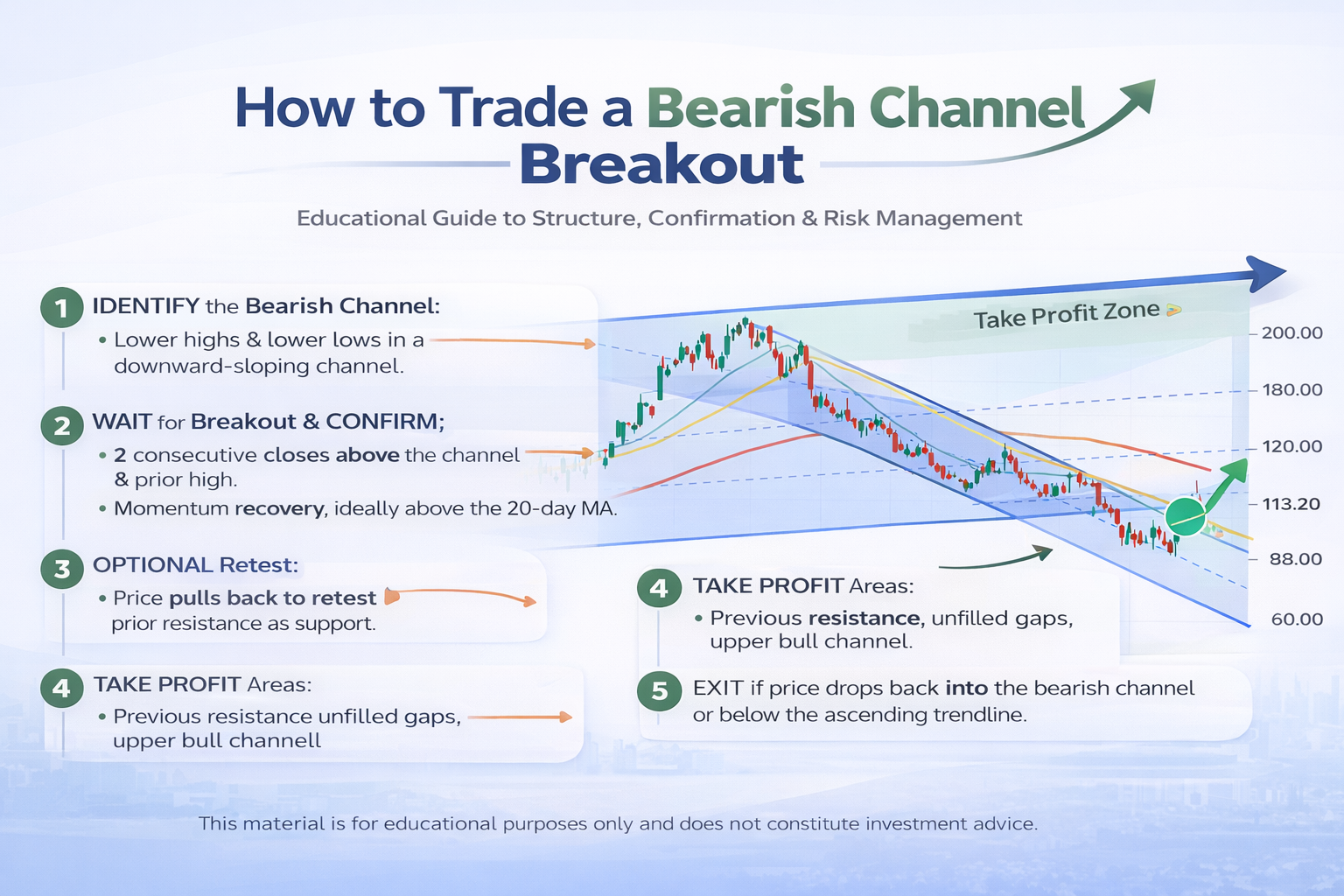
An Educational Guide to Structure, Confirmation & Risk Management
In this article, we share our approach to analysing and trading a bearish channel breakout, using price action, structure, and confirmation, rather than prediction.
1) Identify the Bearish Channel
A bearish channel is formed when price creates:
- Lower highs
- Lower lows
- Within two downward-sloping parallel trendlines
This structure reflects controlled selling pressure.
📌 The key idea:
We are not interested in trading inside the channel — we focus on what happens when price breaks it.
2) Wait for the Breakout (No Anticipation)
A breakout alone is not enough.
Many false breakouts occur, especially in trending markets.
Instead of reacting immediately, we wait.
3) Confirmation Rules (Critical Step)
We look for strong confirmation before considering any directional bias:
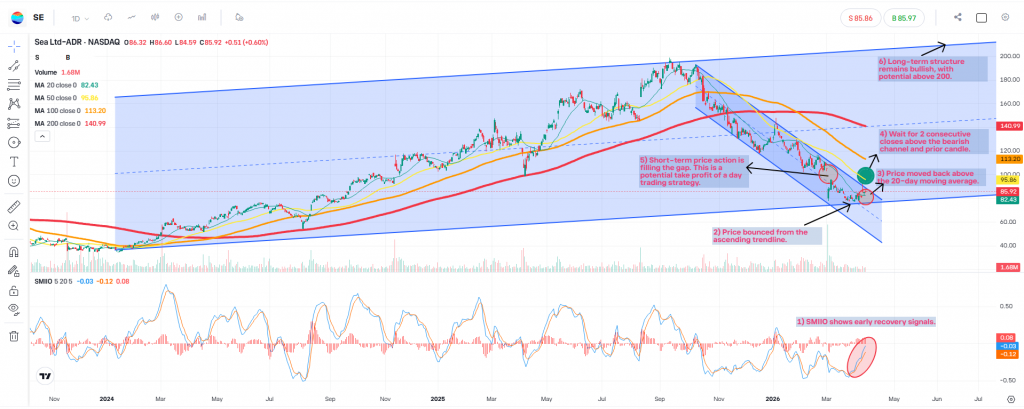
- At least 2 consecutive daily closes above the bearish channel
- Each candle should close higher than the previous one
- Price should ideally:
- Move above the 20-day, and 200-day moving average
- Show momentum recovery (e.g. SMIIO turning upward)
📌 This tells us:
- Selling pressure is weakening
- Buyers are gaining control
- Structure is shifting
4) Retest (Optional but Strong Signal)
In many cases, price may:
- Break the channel
- Then pull back (retest) the breakout zone
If the previous resistance (channel top) holds as support → this strengthens the setup.
5) Take Profit Areas (Structure-Based)
We do not “guess” targets — we use structure.
Potential take profit areas include:
- Previous resistance levels
- Unfilled gaps
- Moving averages (50 / 100 / 200)
- Upper boundary of a larger bullish channel
📌 In this example:
- Price is filling the gap → short-term opportunity
- Longer term → price may aim towards the upper channel (~200 region) if structure holds
6) Exit Strategy (Risk Management)
This is the most important part.
If the breakout fails:
- Price drops back inside the bearish channel, OR
- Breaks below the bullish support / ascending trendline
👉 We exit.
No hesitation.
📌 Key rule:
If structure fails, the trade idea is invalid.
7) What We’re Really Trading
We are not trading:
- Indicators
- Predictions
- Opinions
We are trading:
- Market structure
- Shift in momentum
- Confirmation of control (buyers vs sellers)
Final Thought
A bearish channel breakout is not about catching the bottom —
it’s about recognising when the trend is losing control and a transition begins.
Patience and confirmation are where the edge comes from.
Disclaimer
This content is provided for educational and informational purposes only and does not constitute investment advice or a recommendation to buy or sell any financial instrument. Markets involve risk, and past performance is not indicative of future results. Always manage your risk and position sizing accordingly.
Leave a Reply