
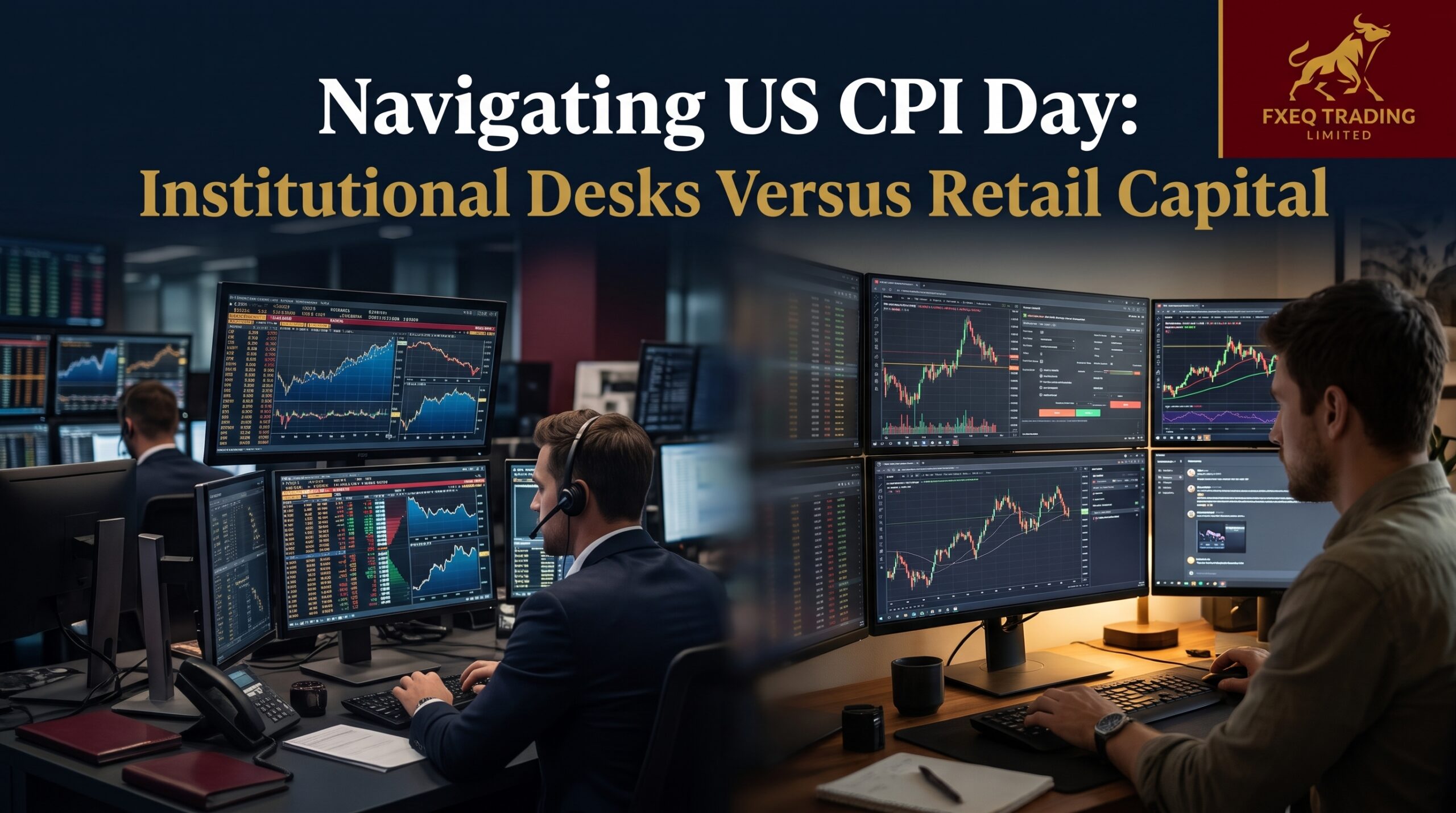
The publication of the United States Consumer Price Index (CPI) is consistently one of the most volatile macroeconomic events in the global financial calendar. Within milliseconds of the release, liquidity providers reprice risk across sovereign debt, currency pairs, equity indices, and bullion.
At FXEQ Trading Limited, we examine market dynamics through two contrasting perspectives: the institutional trading desk and the individual market participant. Understanding how market structure, liquidity availability, and order execution operate during high-impact data releases is essential for developing sound market awareness.
Macroeconomic Transmission: Cross Asset Reactions
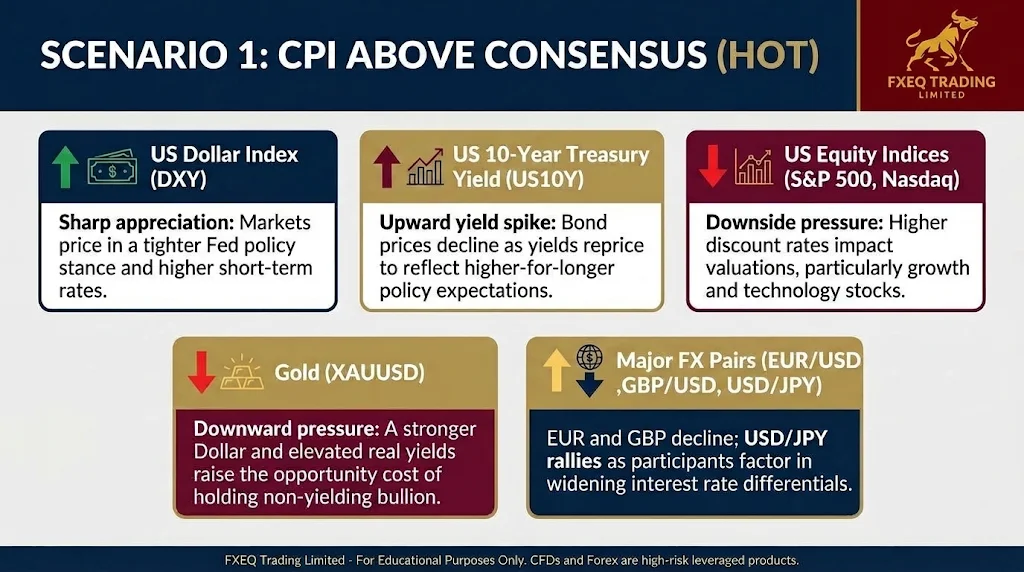
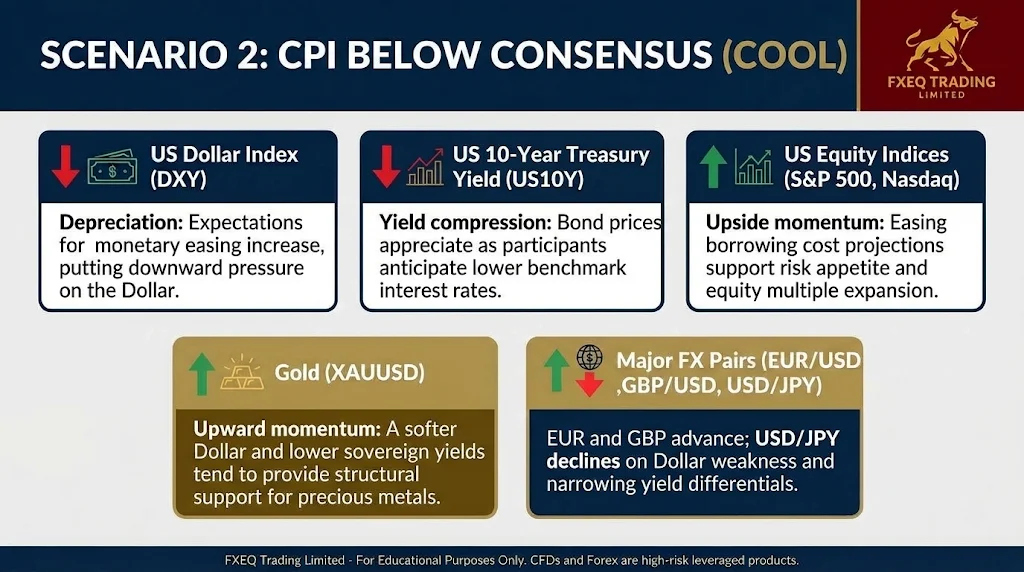
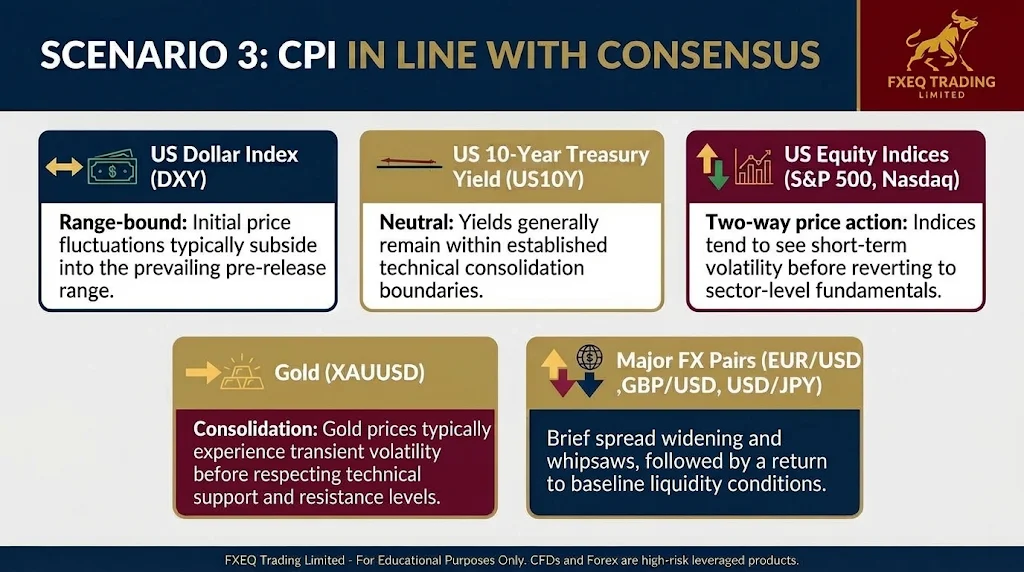
Asset prices adjust relative to consensus expectations rather than the absolute figures themselves.The following infographics illustrate the standard technical and structural reactions observed across key global assets:
The Institutional Reality: What a Head of Trading Desk Does
For a head of a trading desk or market making operation, acute volatility is not an unquantifiable hazard. It is the desk’s primary engine for turnover, spread capture, and inventory turnover.
Unlike retail participants who navigate directional price swings, an institutional dealing desk operates on balance sheet velocity, liquidity bridge architecture, and quantitative flow profiling. Ahead of Tier-1 macro releases such as US CPI, desks adjust their exposure models based on the structural behavioural patterns of incoming flow:
- Asymmetric Hedging & Flow Segmentation: Desk risk managers continuously profile order flow into differentiated risk books. Smaller, highly leveraged positions often suffer rapid margin degradation under severe spread expansion and market whipsaws. Recognising that these under capitalised positions lack the margin buffer to survive intraday volatility spikes, desks may choose to widen execution spreads and loosen external liquidity hedges, allowing internal capital to absorb the transient order flow without passing execution fees to external prime brokers.
- Capitalised Account Hedging & Adverse Selection: Conversely, the desk takes a markedly different approach with well capitalised individual accounts and larger balance sheet holders. Because these participants possess the margin capacity to absorb extended drawdowns, add liquidity into adverse price moves, or scale aggressively, their positions present directional and skew risk to the house. To mitigate tail risk, dealing desks maintain disciplined, active external hedging on these larger tiers, systematically passing their exposure through to Tier-1 liquidity providers to maintain strict Value at Risk (VaR) parameters.
- Inventory Balancing Over Market Prediction: The primary objective of the trading desk is never directional speculation. Desks do not gamble on the CPI print. Instead, they optimise the trade lifecycle, capturing the bid-ask spread across two-way turnover, mitigating adverse selection through dynamic routing bridges, and monetising transaction velocity while preserving regulatory capital buffers.
Comparative Architecture: How the Desk Categorises Order Flow
| Operational Dimension | Standard Leveraged Retail Flow | High-Net-Worth / Institutional Flow |
| Typical Account Profile | High leverage, tight margin buffers, sensitivity to volatility whipsaws. | Substantial margin equity, multi-tiered liquidity absorption, lower leverage. |
| Desk Risk Strategy | Internalised flow; hedges loosened to monetise spread expansion and turnover. | Direct STP / active STP hedging to prime brokers to eliminate balance-sheet skew. |
| Execution Mechanics | Captured within internal book matching engines and clearing buffers. | Routed dynamically across external liquidity bridges and institutional venues. |
| Desk Objective | Spread capture and turnover efficiency during margin displacement. | Counterparty exposure containment and market risk neutralisation. |
The Retail Reality: Capital Preservation Above All
Individual traders operate under a completely different risk profile. As an individual trader, nobody knows what the CPI data will be, and guessing high-impact economic prints is pure gambling.
Your primary objective on CPI Day is simple: protect your capital first, seek profit second.
- Reduce Exposure Before the Print: If you are flat or lightly positioned, stay on your hands until the initial slippage and spread widening clear out.
- De-risk Profitable Holdings: If you already hold open positions showing solid unrealized gains, do not leave them exposed to full sized whipsaws. Take partial profits and engage a Trailing Stop Loss.
By trailing your stop upward (in a long position) or downward (in a short position), you give the market space to run if the reaction favours your direction, securing the maximum possible gain while ensuring that an adverse reversal locks in a protected profit rather than a loss.
Understanding the Trailing Stop Loss (and the Limit Order Reality)
A Trailing Stop Loss is a dynamic order that automatically adjusts your stop level by a preset distance (in pips, points, or percentage) behind the current market price.
- If the market moves in your favour, your stop level tightens behind it, locking in unrealised gains.
- If the market turns against you, the stop remains fixed at its highest (or lowest) reached level, triggering an exit when hit.
The Execution Reality Check: No Guarantees
Traders often misunderstand order execution under event driven volatility:
- Trailing Stop Orders Become Market Orders: Once your trigger price is touched, the trailing stop sends a market order to the execution venue. In a fast moving, gapping CPI market where liquidity suddenly disappears, slippage can and does occur. Your order fills at the next available market price, which may be significantly worse than your trigger price.
- Limit Orders Have No Fill Guarantees: A Limit Order guarantees a specific price or better, but it does not guarantee execution. If price gaps over your limit during CPI volatility, your order may sit unfilled while the market runs away.
- Platform Dependencies: On desktop terminals such as MetaTrader, a native trailing stop runs on your local machine, not the broker’s server. If your terminal disconnects or loses power right at 13:30 GMT, the stop will not trail.
CPI Trading: Capital Preservation Over Event Volatility
Trading around CPI requires complete separation between institutional mechanics and retail psychology. The trading desk profits because its business model is engineered around structural volume and spread capture. As an individual trader, your edge is not speed or liquidity access. It is your patience, your sizing discipline, and your refusal to risk hard earned balance sheet equity on a coin toss data print.
Disclaimer: FXEQ Trading Limited operates strictly as an independent publishing house and educational portal. All materials provided are for informational and educational purposes only and do not constitute financial or investment advice.
Leave a Reply